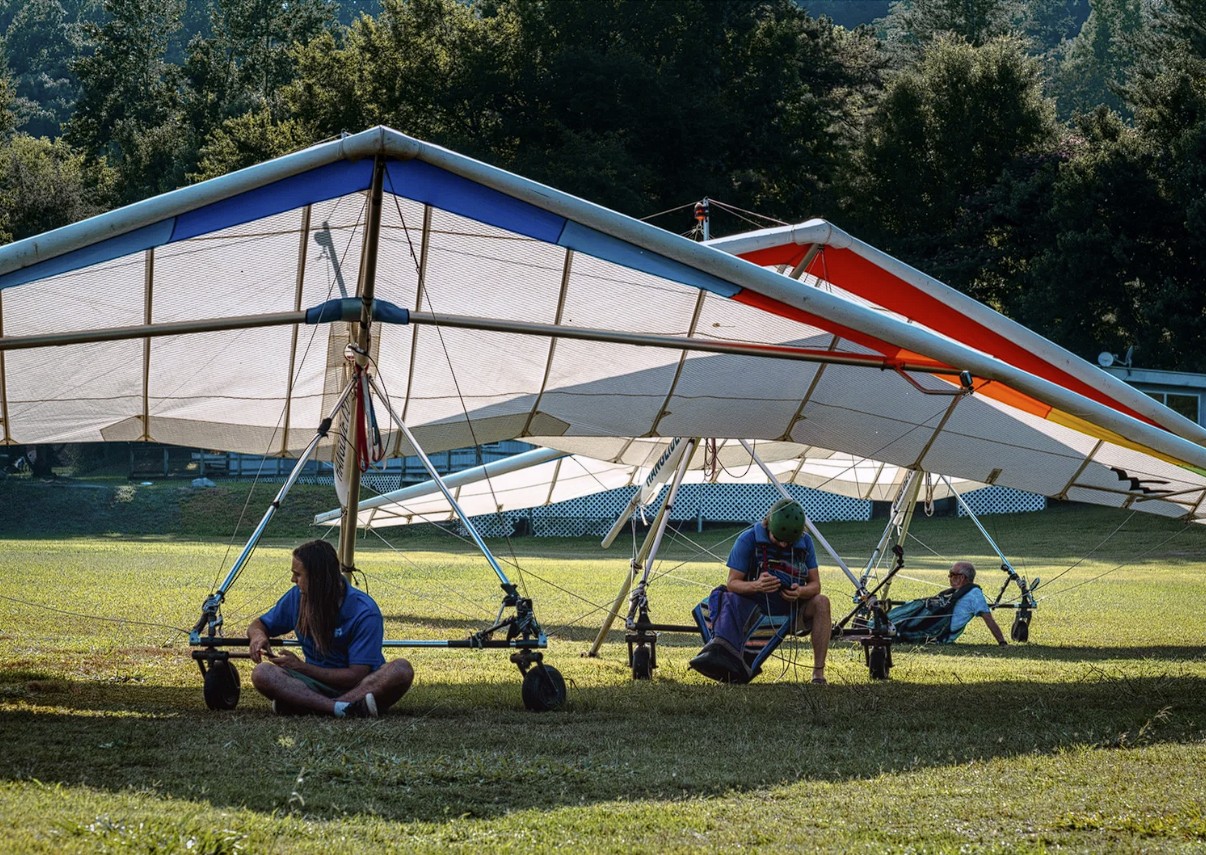
The windsock hangs like a dead fish.
You arrived at 9am. You watched the forecast the night before and it looked promising. Now it’s 10:30 and the air is flat and warm and the sky has that pale, washed-out look that experienced pilots recognize as patience weather.
Nobody is going anywhere for a while.
This is hang waiting. And if you’ve been flying long enough, you know it’s not the opposite of flying. It’s part of flying.
The rituals
Everyone has their version.
Some pilots pull out their glider and lay it in the grass for no operational reason. It’s already rigged. It’s been rigged since they parked. But there’s something about having it out, running hands along the leading edge, checking the nose plate, doing the pre-flight you already did, that makes the waiting feel purposeful.
Some people watch the windsock with the focus of someone waiting for a text. A twitch. A half-rotation. A slow unfurl followed by collapse. Every movement is analyzed, debated, held up to memory. “That looked like it wanted to cycle.” “That’s thermic.” “That’s rotor off the ridge, ignore it.”
Some people open three weather apps and compare them like contradictory witnesses.
And then there are the cloud watchers.
A single cumulus forming over the ridge becomes a group project. Is it growing or dying? It looked bigger ten minutes ago. No, it definitely looked smaller. Someone pulls up a satellite loop. Someone else just stares at it with the intensity of a person defusing something.
A bird appears. One bird, far off, barely visible, doing lazy circles over the valley floor.
“Is that a thermal?”
It might be. It might be a turkey vulture working a dead possum on the county road. Nobody knows. But for a moment, the whole staging area has oriented toward a single speck in the sky like a field of sunflowers tracking the sun. Hope is irrational and pilots have plenty of it.
Some people just sit in a camp chair and drink coffee and look at the sky, and they are the wisest ones.
The conversations
There is no better place to learn to fly than in a staging area on a blown-out morning.
Pilots who’ve been doing this for twenty years will talk to you like you’re a colleague, not a student. The stories come out sideways, embedded in observations. Someone will start talking about the convergence and end up telling you about a flight they did over a ridge in Colorado in 2009 that they still think about. Someone will pull out their phone to show you a track log and you’ll spend an hour going over it like a map of something that mattered.
A senior pilot will tell you exactly what to look for before committing to the soaring bowl. Another will explain why they always add five degrees to their glide angle estimate in unfamiliar terrain. Nobody is teaching. Everyone is thinking out loud.
This is where the knowledge lives. Not in manuals. In conversations between people who waited together and flew together and came back to talk about it.
The gear that comes out
A slow morning means every pilot’s personal relationship with their equipment becomes visible.
Someone is reorganizing their harness pockets for the fourth time this season. Someone else has produced a buffing cloth and is doing something to their uprights. There’s always one person completely dismantling and reassembling their vario mount, which leads to a fifteen-minute conversation about varios, during which at least two other pilots rethink their entire vario situation.
One pilot drives to a gas station for snacks and comes back a hero.
The gliders catch the light as the morning moves. Even still, there’s something about a hang glider laid out in the grass that looks like intention. Like it’s waiting too.
The wind whisperer
Every flight park has one.
They’re usually sitting apart from the main group, in a chair that looks like it has been there since the Clinton administration. They are not checking weather apps. They are not watching the cloud. They looked at the sky once when they arrived, made a private calculation, and have been largely unimpressed by the evidence since.
When someone runs over breathless about the bird, or points at the cloud, or declares that the windsock definitely moved, the wind whisperer does not look up. They take a sip of whatever is in their cup and say, with complete calm, that conditions won’t be right until 2pm.
It is 11am.
They are never wrong.
The false positives do not touch them. They have been fooled before, many times, by many birds and many clouds, and they have metabolized those lessons into something that looks like indifference but is actually just accurate calibration. They know that the cloud is not the indicator. The bird is not the indicator. The rogue gust that got everyone excited for thirty seconds is not the indicator.
They know what the indicator is.
What the waiting teaches you
It teaches you to read the sky without demanding an answer from it.
It teaches you patience that is different from resignation. You’re not giving up on the day. You’re letting the day arrive at its own pace. There’s a version of this that pilots spend years learning: to stop pressing, to stop calculating, to stop asking the conditions to hurry up. To just be there, on the ground, with your glider and your people, until the air decides it’s ready.
Some of the best flying days of my life started with three hours of nothing happening. The kind of nothing that sits just before everything.
When it finally happens, nobody announces it. Someone points at the cloud. Someone mentions the bird came back. The windsock stirs.
But the pilots who have been around long enough aren’t looking at any of that.
They’re watching the wind whisperer fold up the lawn chair.
That’s the signal. That’s always been the signal. When the wind whisperer starts suiting up, you suit up. No further analysis required.
The waiting had been its own thing. What came after was its own thing. Both were worth getting up for.